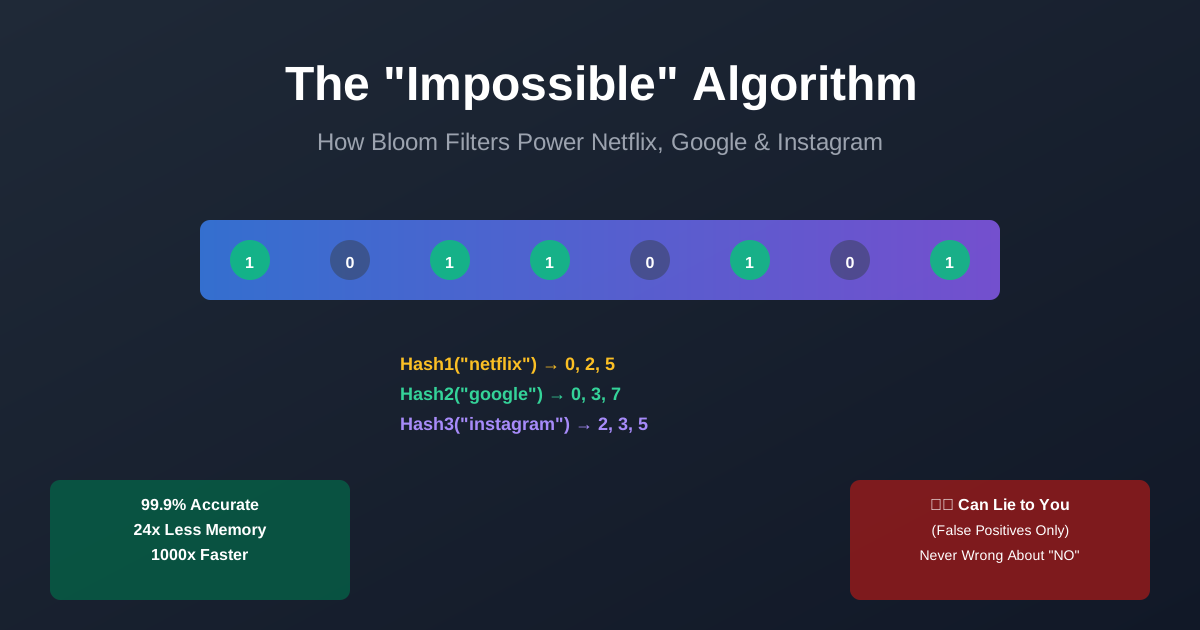
The 30-Year-Old “Impossible” Algorithm That Makes Netflix Instant
Netflix can tell you if a movie exists in 0.1 seconds across 15,000 titles. Your computer takes 10 seconds to find one file on your desktop.
What’s the difference? A probabilistic data structure called a Bloom Filter that seems to break the laws of computer science.
🤯 Mind-Blowing Fact
Bloom Filters can be 99.9% accurate while using 24x less memory than traditional databases. But here’s the kicker: they can lie to you… and that’s exactly why they work.
The Problem That Broke the Internet (Almost)
Picture this: It’s 2005. MySpace has 100 million users. Every second, thousands of people are trying to create accounts with usernames like “coolkid123” and “rockstar2005.”
Each time someone types a username, the system asks: “Is this taken?”
Traditional approach? Check every single username in the database. That’s like having a librarian manually flip through every book in the Library of Congress just to tell you if they have Harry Potter.
The result? Servers melting. Users waiting. Companies losing millions.
Enter Burton Howard Bloom, a programmer who in 1970 proposed something that sounded impossible:
What if we could answer ‘Is this taken?’ with 99.9% accuracy, using almost no memory, and be 1000x faster than any database?
His colleagues probably thought he was crazy. They were wrong.
The Magic Toy Box Analogy
🧪 Interactive Bloom Filter Demo
Bit Array (8 bits):
Add Item to Filter:
Check if Item Exists:
Items in Filter (0):
How it works:
- • Each item gets hashed to 3 different positions
- • Those positions are set to 1 in the bit array
- • To check: if ALL 3 positions are 1, item "might" exist
- • If ANY position is 0, item "definitely doesn't" exist
Imagine you have a magic helper who watches your toy box. This helper has a special piece of paper with 8 empty circles:
○ ○ ○ ○ ○ ○ ○ ○When you put toys in the box:
- Add teddy bear → Helper colors circles 1, 3, and 6:
● ○ ● ○ ○ ● ○ ○ - Add toy car → Helper colors circles 2, 4, and 7:
● ● ● ● ○ ● ○ ●
When you ask “Is my ball in the box?”
- Helper checks if circles 2, 5, and 8 are colored
- Circle 5 is empty → “Definitely NOT in the box!” ✅
- Helper is 100% correct when saying NO
When you ask “Is my teddy bear in the box?”
- Helper checks circles 1, 3, and 6
- All are colored → “Maybe in the box!” ⚠️
- Helper could be wrong when saying YES (false positive)
This is exactly how Bloom Filters work, just with usernames instead of toys and hash functions instead of magic.
The Plot Twist That Changes Everything
Here’s where your brain breaks: Bloom Filters can lie, but only in one direction.
The Bloom Filter Promise:
- ✅ Never wrong when saying “definitely NOT there”
- ⚠️ Sometimes wrong when saying “might be there”
Why is this useful? Because false negatives are catastrophic, but false positives are just annoying.
- False negative: “Sorry, @elonmusk is available!” → User takes a username that’s actually taken → System breaks
- False positive: “Sorry, @randomname123 might be taken” → User tries a different name → No big deal
How Big Tech Uses This “Broken” System
🏢 How Big Tech Uses Bloom Filters
Netflix
Content Discovery
How They Use It:
Instantly filters out irrelevant movies/shows before expensive database searches. Powers the "Continue Watching" and recommendation systems.
📈 Business Impact
Sub-second search across 15,000+ titles
⚡ Performance Stats
99.7% faster content lookup
⚡ Traditional Database vs Bloom Filter
❌ Without Bloom Filter
- • Every check hits database
- • O(log n) lookup time
- • High server load
- • Expensive at scale
✅ With Bloom Filter
- • Most checks avoid database
- • O(1) constant time
- • Minimal memory usage
- • Scales to billions of items
Netflix: Finding Your Next Binge
Netflix doesn’t actually search through every movie when you type “action movies.” Instead:
- Bloom Filter instantly says “definitely no sci-fi movies with that title”
- Database only searches the remaining possibilities
- Result: Sub-second search across 15,000+ titles
Google: Crawling the Internet
When Google’s bots crawl the web, they use Bloom Filters to avoid re-visiting the same pages:
- Without Bloom Filter: Check 50 billion URLs against a database (impossible)
- With Bloom Filter: Instant “definitely haven’t seen this” or “maybe I have” (blazing fast)
Instagram: Username Validation
When you type @newusername:
- Bloom Filter: “Definitely available” or “might be taken”
- If maybe taken: Quick database check
- Result: Most checks never hit the database
Bitcoin: Transaction Validation
Bitcoin nodes use Bloom Filters to quickly identify relevant transactions without downloading the entire blockchain.
The Mathematics of “Impossible”
Let’s get nerdy for a second. Here’s why Bloom Filters seem to break physics:
Traditional Database:
- Space: O(n) - grows with data
- Time: O(log n) - gets slower as data grows
- Accuracy: 100%
Bloom Filter:
- Space: O(1) - fixed size forever
- Time: O(k) - constant time always
- Accuracy: 99.9% (configurable)
The trade-off: Perfect accuracy for near-perfect speed and efficiency.
Interactive Challenge: Test Your Understanding
🧠 Test Your Understanding
A Bloom filter says an item 'definitely exists'. What can you conclude?
Real-World Impact: The Numbers Don’t Lie
Here’s what happens when you deploy Bloom Filters at scale:
- Akamai: Processes 30% of global web traffic using Bloom Filters
- Facebook: Filters billions of spam messages daily
- Cassandra: Reduces disk reads by 95% using Bloom Filters
- Chrome: Uses Bloom Filters to block malicious URLs instantly
💰 Business Impact
Companies report saving millions in server costs and improving user experience dramatically after implementing Bloom Filters.
The Dark Side: When Bloom Filters Attack
Not everything is perfect in Bloom Filter land. Here are the gotchas:
1. The False Positive Problem
As your Bloom Filter fills up, false positives increase exponentially. At some point, it starts saying “maybe” to everything.
2. No Deletions (Usually)
Traditional Bloom Filters can’t remove items. Once something is “in,” it’s in forever. (Though Counting Bloom Filters solve this.)
3. Size Matters
Too small → High false positive rate Too large → Wastes memory Just right → Goldilocks zone of efficiency
Building Your Own: 10 Lines of Code
Want to implement a basic Bloom Filter? Here’s a minimal version:
class BloomFilter {
  constructor(size) {
    this.size = size;
    this.bits = new Array(size).fill(false);
  }

  hash(item, seed) {
    // Simple hash function (use better ones in production)
    let hash = seed;
    for (let i = 0; i < item.length; i++) {
      hash = ((hash << 5) + hash + item.charCodeAt(i)) % this.size;
    }
    return Math.abs(hash);
  }

  add(item) {
    const hash1 = this.hash(item, 1);
    const hash2 = this.hash(item, 2);
    const hash3 = this.hash(item, 3);

    this.bits[hash1] = true;
    this.bits[hash2] = true;
    this.bits[hash3] = true;
  }

  mightContain(item) {
    const hash1 = this.hash(item, 1);
    const hash2 = this.hash(item, 2);
    const hash3 = this.hash(item, 3);

    return this.bits[hash1] && this.bits[hash2] && this.bits[hash3];
  }
}

// Usage
const filter = new BloomFilter(100);
filter.add("username123");
console.log(filter.mightContain("username123")); // true (definitely maybe)
console.log(filter.mightContain("newuser456"));   // false (definitely no)
The Future: Bloom Filters Evolved
The basic Bloom Filter was just the beginning. Modern variants include:
- Counting Bloom Filters: Support deletions
- Scalable Bloom Filters: Grow dynamically
- Stable Bloom Filters: Continuously evict old data
- Blocked Bloom Filters: Cache-friendly implementations
Your Mind = Officially Blown
Bloom Filters prove that sometimes “good enough” is better than perfect. By accepting a tiny bit of uncertainty, we unlock massive gains in speed and efficiency.
The next time Netflix loads your recommendations instantly, or Google blocks a malicious website before you click it, remember: there’s probably a Bloom Filter working magic behind the scenes.
Was your mind blown? Share this article and tag three programmer friends who need to see this. Let’s spread the Bloom Filter love! 🤯
Follow me for more deep dives into the algorithms that power your favorite apps.


Discussion